Solutions for those exercises.
Questions
-
What is the keyword used to call the constructor from the base class?
-
this. - the name of the base class.
-
base -
over -
inherits
-
-
Inheritance is …
- … a way of implementing a class by re-using another class’ code.
- … impossible to represent in a UML diagram.
- … achieved using the
;(semicolon) symbol. - … a way of connecting a basic class with a derived class.
-
Suppose your are given an
ElectricDeviceclass and aWallDecorclass. You would like to write aClockclass that represents at the same time an electric device and a wall decor. This is possible only if theElectricDeviceandWallDecorclasses are…- Sealed
- Interfaces
- Protected
- Constructors
-
An abstract class…
- … can be instantiated.
- … can contain a constructor.
- … can contain abstract and non-abstract methods.
- … is represented in a UML diagram by prefixing its name with <<Abstract>>.
-
In a UML diagram, an abstract method is …
- … underlined.
- … impossible to distinguish from a non-abstract method.
- … necessarily part of an abstract class.
- … in italics.
-
A class
Studentinheriting from an abstract classPerson…- … must override all of
Person’s methods. - … must implement all the methods marked
abstractinStudent. - … can be instantiated.
- … is connected to
Personusing an open triangle end and a continuous line (⇽) on the UML diagram. - … is connected to
Personusing an open triangle end and a dashed line (◁┈) on the UML diagram.
- … must override all of
-
A method with header
public virtual void Test(int a, out int b)will…- Return a value
- Set the value of
b - Require two arguments
- Be overrideable
-
A method with header
public abstract string Test()will…- Have an empty body
- Need to be inside an
abstractclass - Not be overriden
-
A method …
- … can be accessed from any class if it is marked
protected. - … can be accessed from its derived classes if it is marked
private. - … is recursive if it terminates.
- … is recursive if it calls itself.
- … must be overridden if it is marked
abstract. - … cannot be overriden if it is marked
sealed.
- … can be accessed from any class if it is marked
-
Give at least two differences between an abstract class and an interface.
Problems
-
Assume given the following class implementation:
class Computer{ private string brand; public void SetBrand(string brandP){brand = brandP;} public Computer(string bP){SetBrand(bP);} public override string ToString(){return $"Brand: {brand}";} }-
Write a
Laptopclass that- Inherits from
Computer, - Has an automatic
doubleproperty calledBattery, - Has a property, called
ScreenSize, of typeint, that throws theArgumentExceptionexception if the argument is 0 or less, - Has a constructor that takes 3 parameters of appropriate
datatypes, and use them to set
Battery,ScreenSizeandbrand(in this order), - Has a
ToStringmethod that returns astringcontaining the battery (expressed as a percentage), the screen size and the brand.
- Inherits from
-
Among the following statements, indicate which are valid:
-
Computer test0 = new Computer(); -
Computer test1 = new Computer("Dell"); -
Computer test2 = new Laptop(.6, 12, "ThinkPenguin"); -
Laptop test3 = new Computer("Dell"); -
Laptop test4 = new Laptop(.6, 12, "ThinkPenguin"); -
Computer test5 = new Computer(.6, 12, "ThinkPenguin");
-
-
Draw the UML diagram for the
ComputerandLaptopclasses.
-
-
Consider the diagram representing the “Room”, “ClassRoom”, “Office” classes and their relations.
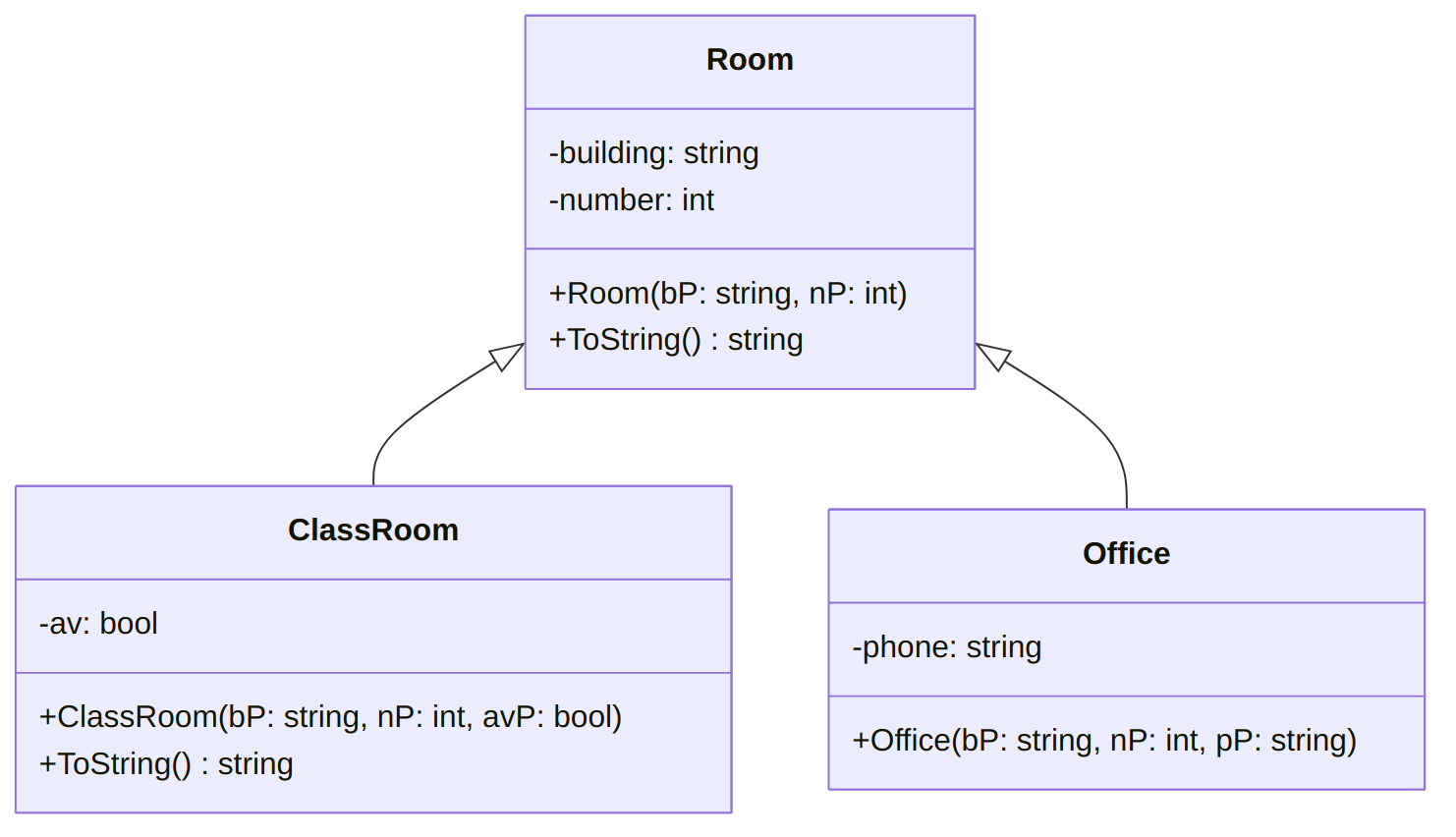
Suppose you are given an implementation of the
Roomclass, such thatRoom test = new Room("UH", 243); Console.WriteLine(test);displays
UH 243-
Write an implementation of the
ClassRoomclass. YourToStringmethod should display the room’s building and number, in addition to whether it has AV set-up. -
Write a
SameBuildingstatic method to be placed inside theRoomclass such thatOffice test1 = new Office("UH", 127, "706 737 1566"); ClassRoom test2 = new ClassRoom("UH", 243, true); Office test3 = new Office("AH", 122, "706 729 2416"); Console.WriteLine(Room.SameBuilding(test1, test2)); Console.WriteLine(Room.SameBuilding(test2, test3));Would display “true” and “false”.
-
-
Consider the diagram representing the “Room”, “BedRoom”, “BathRoom” classes and their relations.
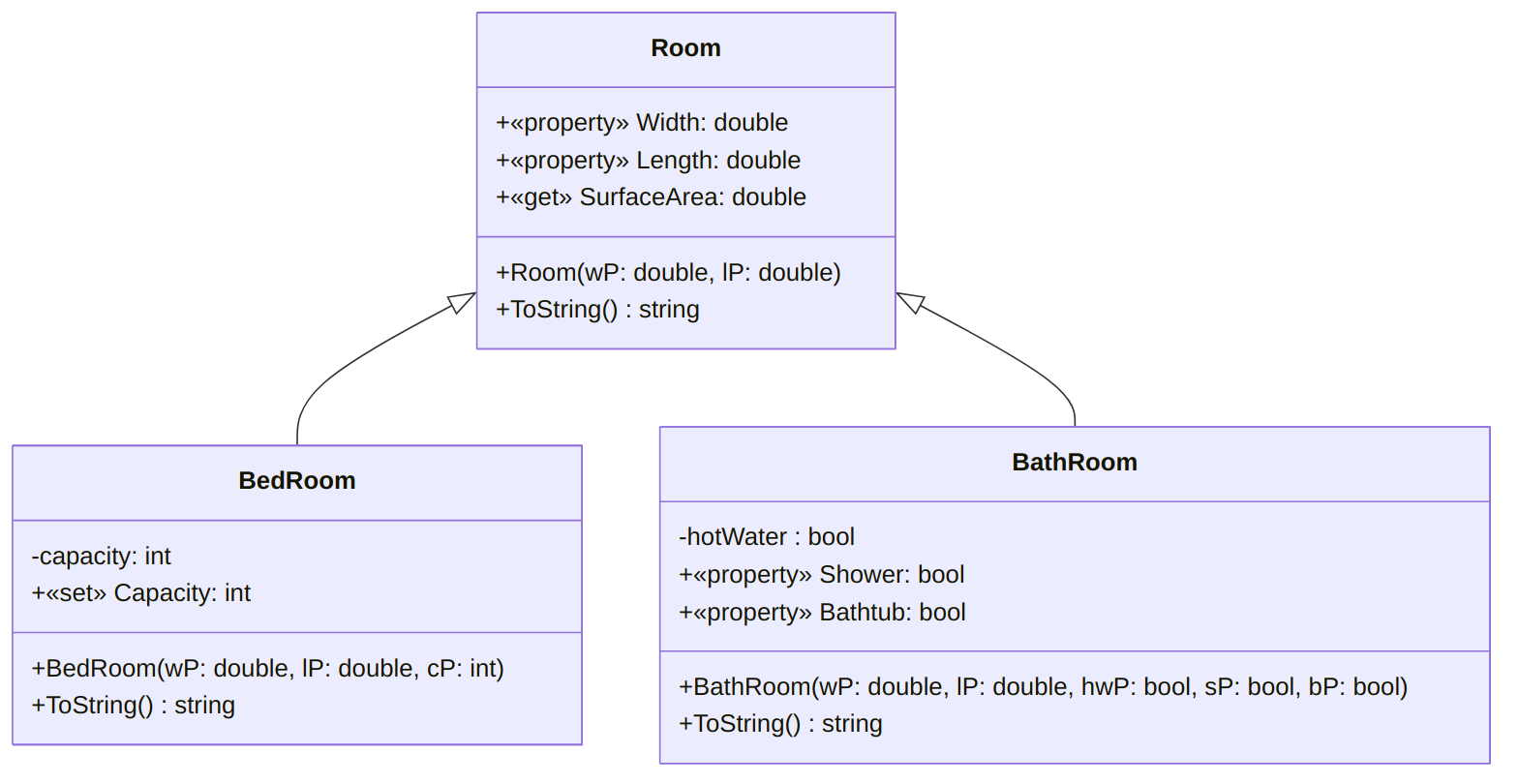
-
Write an implementation of the
SurfaceAreaproperty for theRoomclass, assuming you are given an implementation of theWidthandLengthproperties. -
Check the statements that would compile, assuming that
rTestis aRoomobject,beTestis aBedRoomobject, andbaTestis aBathRoomobject.-
rTest.Capacity = 12; -
baTest.Width = 12; -
beTest.capacity = 3; -
rTest.SurfaceArea = -2; -
baTest.Capacity = 3; -
beTest.Shower = true; -
Console.WriteLine(baTest.ToString());
-
-
Write a complete implementation of the
BedRoomclass.- Your
Capacityproperty should use thecapacityattribute, and throw an exception if the argument given is strictly less than 1. - Your
ToStringmethod should complement theRoom’sToStringby appending to itsstringthe capacity (in person) of theBedRoomobject.
- Your
-
Write the
ToStringmethod of theBathRoomclass, knowing that a disclaimer should be part of thestringreturned if theBathRoomhas a shower or a bathtub but no hot water.
-
-
Consider the diagram representing the “Article”, “Book” classes and their relations.
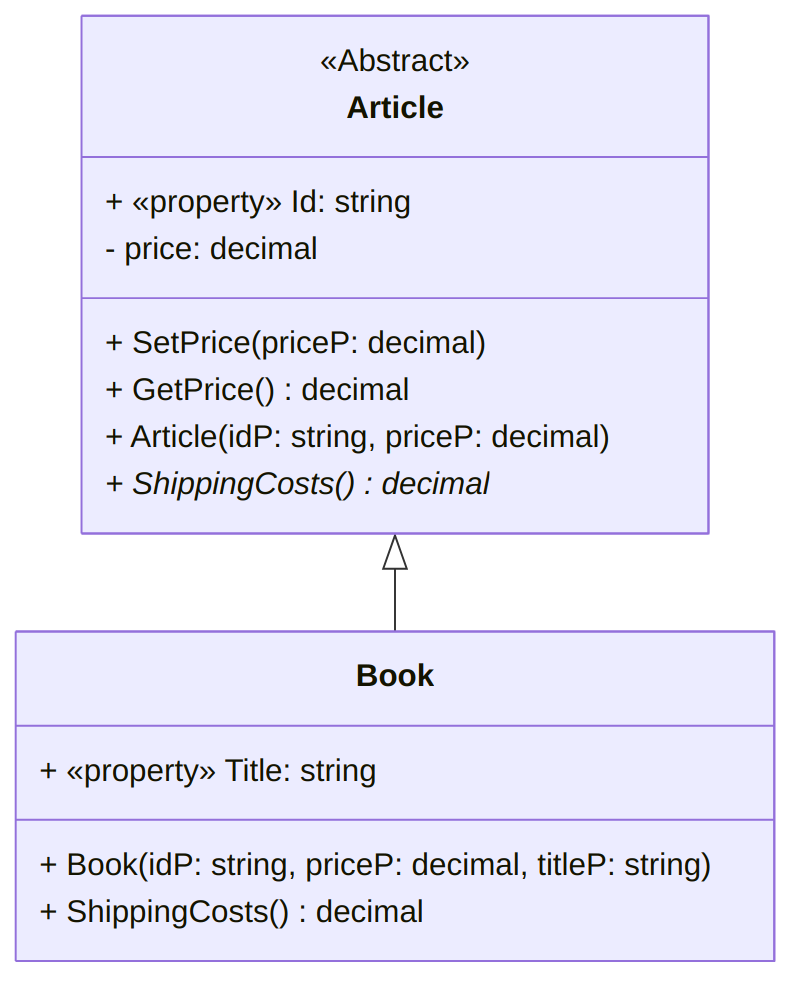
-
Write a (partial) implementation of the
Articleabstract class:- Write an implementation for the
priceattribute: you can either use a getter and a setter (as pictured in the UML diagram), or a property. However, in both cases, setting the price to a negative value should result in anArgumentOutOfRangeExceptionexception being thrown. - Write an abstract
ShippingCosts()method.
- Write an implementation for the
-
Now, assume given a complete implementation of the
Articleabstract class. Write a complete implementation of theBookclass (header included), containing:- An implementation of the
Titleproperty using auto-properties. - A
Bookconstructor that passes theidPandpriceParguments to theArticleconstructor. ThetitlePargument should be assigned to theTitleproperty. - A
ShippingCosts()method that returns either 5.0, or 10% of the Book’s price, whichever is smallest.
- An implementation of the
-
Write statements that, if placed in a
Mainmethod, would- Create a
BookwithId“AAA001”,price$12.5, titled “What it’s like to be a bird”. - Display (nicely) its shipping costs.
- Display its
Id(as retrieved from the object).
- Create a
-
-
Consider the diagram representing the “Shape”, “Circle” and “Rectangle” classes, as well as their relations.
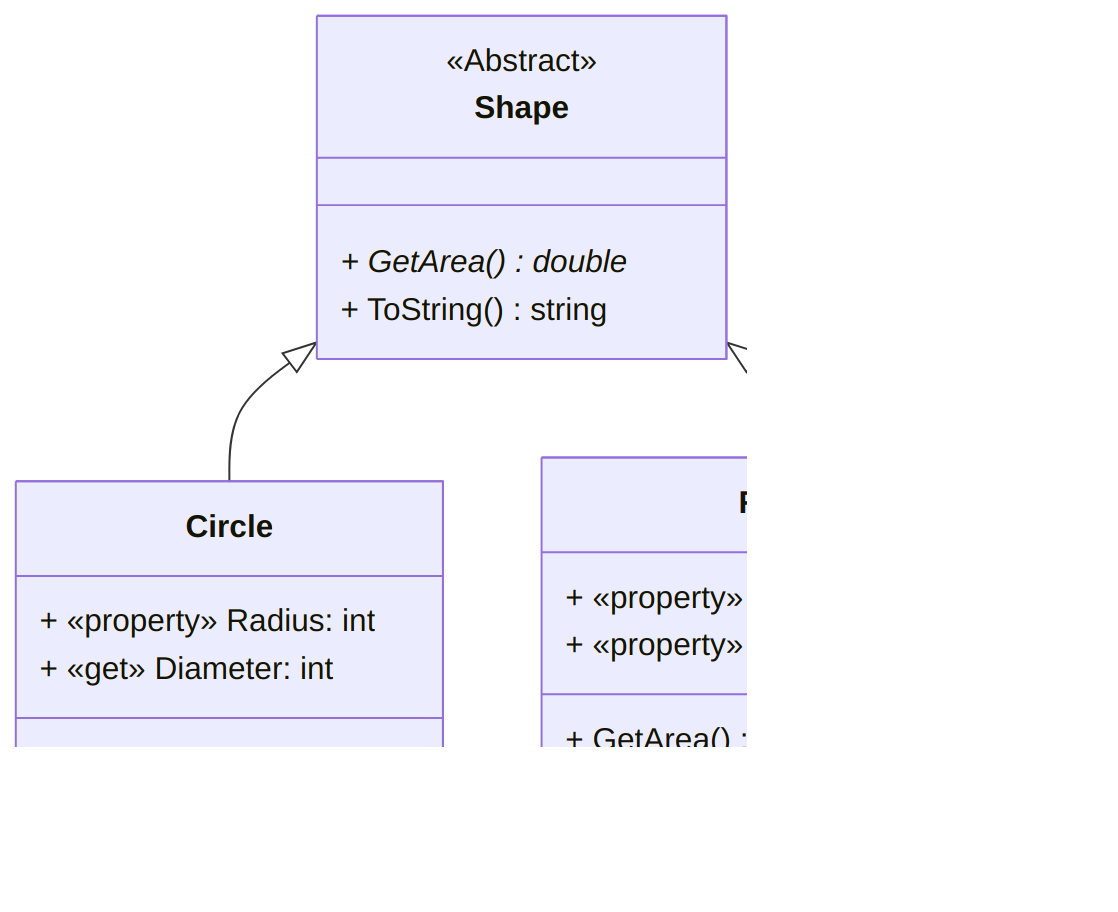
-
Write the complete implementation of the
Shapeabstract class. TheToStringmethod should simply return the string"This shape is ". -
Write an implementation for the
Radiusproperty of theCircleclass such that setting the radius to a negative value would result in anArgumentOutOfRangeException(that you can shorten toAOORE) exception being thrown. Add an attribute if needed. -
Write the
Diameterproperty for theCircleclass, which should return times the radius. Only thegetshould be provided: briefly explain why thesetis missing. -
Write an implementation for the
ToStringmethod of theRectangleclass that returns astringcontaining what was returned by theShape’sToStringmethod, the width, length and area of the calling object. For example, for aRectanglewith width 10 and length 5, it should be of the form “This shape is a rectangle (W: 10, L: 5, Area: 50)“. -
Write the
Equalsmethod for theRectangleclass. It should returntrueif the calling object and the parameter have the same lengths and same widths, or if one can be obtained by rotating the other. -
Briefly explain how
Shapecould be converted into an interface and what would be the benefit(s) and disadvantage(s) of carrying out such a modification.
-


